# Datafields

### @assigned <a href="#assigned" id="assigned"></a>

* parameter: a datafield
* returns true or false
* see also: @implemented and @cascade

Returns true if *some* value is assigned to the datafield (i.e., if the datafield is not equal to *unassigned).*

Tip: you can easily invert the behaviour of this special function: `not(@assigned(#concept^datafield))` will return true if the datafield is *not* assigned any value.

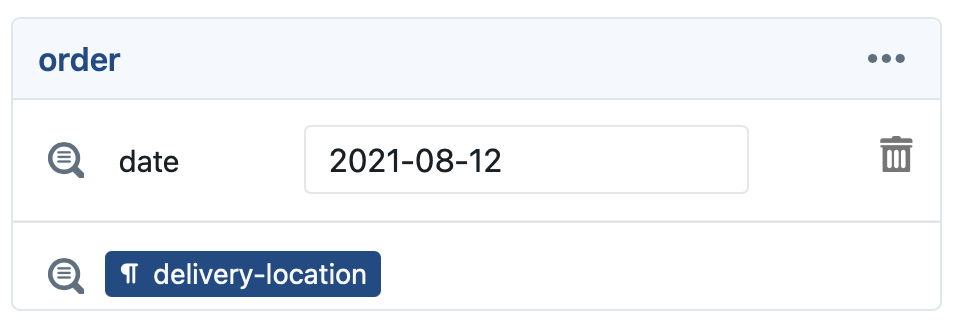
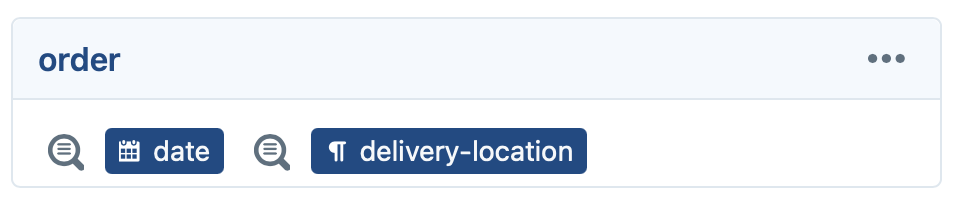
In visual terms, the `@assigned` function actually boils down to the question whether the data dashboard shows the left side (= no value assigned) or the right side.

<figure><img src="https://1353649376-files.gitbook.io/~/files/v0/b/gitbook-x-prod.appspot.com/o/spaces%2FaTEDNbiFdDa6DW2eNG17%2Fuploads%2F2iGIRtMVIrVkrPJpOfkD%2Fimage.png?alt=media&#x26;token=1a6a89c7-885f-4e29-8434-74f2f41de010" alt="" width="563"><figcaption><p><code>date</code> and <code>delivery-location</code> are not assigned any value</p></figcaption></figure>

<figure><img src="https://1353649376-files.gitbook.io/~/files/v0/b/gitbook-x-prod.appspot.com/o/spaces%2FaTEDNbiFdDa6DW2eNG17%2Fuploads%2FcxjsbW2JrC0QgQMyuNZK%2Fimage.png?alt=media&#x26;token=9ebb1cd5-5080-43ee-b4bf-1b4208111fa2" alt="" width="375"><figcaption><p><code>date</code> is assigned a value (so that <code>@assigned(#order^date)</code> would return <code>true</code>), while <code>delivery-location</code> is still not assigned a value</p></figcaption></figure>

{% hint style="danger" %}
The `@assigned` function may cause quite some surprises for new users.

Be aware that assigning an *empty text* value to a text datafield (visually shown in the data dashboard as an empty text box) causes the `@assigned` function to return true for that datafield.\
\
Similar surprises will happen with:\
\* assigning the value *false* to a true/false datafield (visually represented as a checkbox that is not checked)\
\* assigning the value 0 to a number datafield\
\* assigning a collection of no items to a list of text or repeating datafield — which will already happen in a Q\&A when a question has been associated with this datafield

because all of these situation cause the `@assigned` function to return true for that datafield, because “something” is assigned (yes, even an empty collection is “something”). This will probably come as a surprise if you are new to thinking in data types.

Tip: to check whether at least one item is assigned to a list of text or repeating datafield, you can use `@count(#concept^datafield) > 0`
{% endhint %}


---

# Agent Instructions: Querying This Documentation

If you need additional information that is not directly available in this page, you can query the documentation dynamically by asking a question.

Perform an HTTP GET request on the current page URL with the `ask` query parameter:

```
GET https://help.clause9.com/special-functions/datafields.md?ask=<question>
```

The question should be specific, self-contained, and written in natural language.
The response will contain a direct answer to the question and relevant excerpts and sources from the documentation.

Use this mechanism when the answer is not explicitly present in the current page, you need clarification or additional context, or you want to retrieve related documentation sections.